September 19, 2007

New Google Presentations!


I am excited that Google has added presentation slides to their docs and spreadsheets app.

I know that Google will most likely take over the world – but they sure are going to make me and other people happy while they do it. Now I can create presentations online.

Too early to tell – but the application seems a little primitive. It seems like it will be great for showing clients presentations in real time or for publishing slides from live presentations.

What will you use this new app for? I’d love to hear suggestions.

September 13, 2007

Steve Garfield

If you've never met Steve Garfield - you are missing out. He is one of the most interesting and fascinating characters I know. Check out my interview with him at Podcamp Philadelphia this past weekend...

Steve Garfield Interview

September 10, 2007

Podcamp Philly 2007


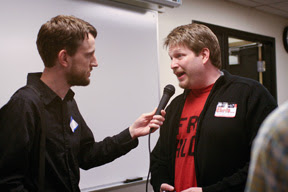
Podcamp Philly was this past weekend. This is me with Paul Kontonis, CEO of For Your Imagination in New York. They are a new media company producing online shows.

Podcamp was awesome! I presented in three sessions – “Thinking Like a Producer” – “Developing Your Elevator Pitch” – and the panel “Podcasting & Blogging for businesses.”

I also got to do several interviews for Folk Media. I’ll post these in the next few days.

In the meantime here are links to coverage of the festivities:

Flickr Stream: http://flickr.com/groups/456399@N25/pool/

3 Clips of PC Philly: By Chris Penn

September 04, 2007

On The Air 24/7

Podcamp is a weird experience. You are being recorded constantly. I logged onto the Podcamp stream on Flickr yesterday and saw my photo flying around the net. Not sure who took the shot and posted it. I don't even remember having my photo taken.

My life is now transparent. So is yours.

It is a lesson in the new media world. Be ready to be on camera at ANY time. The whole weekend was also streamed live over Justin.TV.

So for those of you who are awake and realize that we are "on air" 24/7 - Here are a few helpful tips for living a life in a new media culture...


Tip #1 - Never assume that you can leave your house without combing your hair.

This seems like basic advice - but I see people do it all the time.

Tip #2 - Always take a camera with you.

You are a media creator too - don't be passive. The best kind of camera is one that can shoot both stills and video. A big plus if it is low key and small.

Tip #3 - You should be ready to capitalize on a good meme when it sprouts up.

A couple guys at podcamp pittsburgh came up with the term Bacn "email you want, but not right now" and it is sweeping the world - thanks to social media. I was there when they created it just a few weeks ago and now they have used media to move a great idea forward.

Tip #4 - Always consider your words.
Be truthful - consistent - and positive. What you say is being captured and it will be available for the whole world. Don't gossip or talk bad about other people. They WILL find out. Always talk positively about other people. They WILL find out - and that is a good thing.

Tip #5 - Be Natural
Act naturally - especially when a camera is rolling. The camera has a way of picking up on insincerity better than the human eye.

Tip #6 - Make boggers and podcasters your friends.
They will paint you in a better light if they like you. Better yet get your own show and begin posting your own content.

Tip #7 - Don't be an idiot.
Do I really need to explain this one?

Tip #8 - Build relationships.
Chris Brogan is a huge proponent of using digital tools to build better relationships. After all isn't this what social media is all about?


What tips do you have for all of us living in an "on the air" world 24/7? Thoughts?

August 30, 2007

Podcasting 101

This past weekend I had the opportunity to co-present a seminar on podcasting basics at the Baltimore Music Festival with Barrett King - producer of Any Given Tuesday (www.anygiventuesday.info). You can listen to the audio here: Podcasting 101 (Barrett King & Joel Mark Witt).

August 25, 2007

The True Cost of Production

I think money is a huge stumbling block for content creators.
They think that if only they had more money their productions would be better quality – or they could market better. Lack of money is definitely a problem for most of us creating new media. So we try to keep our financial costs low.

But there are more costs than just financial.
Good producers and creators keep their financial budget to a minimum and spend very little money while keeping production values as high as possible. Great producers and creators keep all their costs in check often times increasing their production values.

There are four basic types of costs.

1. money
2. time
3. cognitive stress (brain power)
4. physical exertion


The highest cost to you is what you have the least of…
If you have all the time in the world – time is a low cost for you. Obviously this is not rocket science. But I say this because people get hung up on money so much. There are other costs to consider.

Your goal is to reduce the costs in each of the four areas.
As a media creator it does you no good to keep your financial costs low and spend a lot in time or physical exhaustion. You will burn out – become resentful – or just plain lose interest or passion for your project. Sit down with your team and sketch out the real costs in each of these four areas.

Map out your cost lowering plan.
If you have limited time – look into bringing more team members on board. If you lack creative ideas (cognitive stress) then find others who can be creative for you. It may take some creativity and imagination.

So what costs you the most during your productions and creative process? How do you deal? I’d like to hear what you think.

August 24, 2007

Interview with Chris Brogan From Podcamp PGH

So I got to interview Chris Brogan this past weekend at Podcamp Pittsburgh 2007.

Chris has some great ideas and insight into social media and community. Check his blog out at www.ChrisBrogan.com

I posted the interview below:

Compliments

I had someone give me a compliment this past week.

Tough.

It's hard to take compliments. How is one supposed to respond? It is tricky - so you don't downplay what they are saying - but you also don't want to come across as cocky.

July 25, 2007

one morning - two things

Not sure exactly - but it was recently. I woke up one day and realized two things.

1. No one is planning my life for me.
What happens to me in this world is a direct result of the actions I take. There is nothing stopping me from doing what I want to do in this life. There is no boardroom of people I have to ask permission from. There are no kings ready to bestow their authority on me. I am free. You are free. I would be curios to hear - how do you handle this freedom?

2. My life is not leading up to something big.
Life is a marathon - but for some reason we all try to make it a sprint toward something grand. All we are really sprinting toward is death. I think this stems from our schooling years. We look forward to graduation like it is the end all of being. Then post graduation we scratch our heads and wonder why it was such a big deal. We expect that the big event of life is just around the corner. We are ever chasing - it is ever eluding.

Yes life can be exciting - life can be grand - life can be epic. But my life does not lead up to anything. I think this knowledge is really helpful. It takes me out of thinking I have to wait around for the big thing to happen. It forces me to focus on today and doing good work.

Do you agree? Do you feel like your life is leading up to something? Or do you feel that life is a journey - rather than a destination? Thoughts?

July 17, 2007

5 Tips for great online video

After launching three online shows I have learned a couple things about video online. Here are my top five tips...

1. Frequency
The more you post the more they come. People want to see a regular flow of content coming from you. Frequency is the best way to build a loyal and expanding audience. Weekly posting is a good rule of thumb. Daily will send you into orbit.

2. Fast paced editing
Video on the web is consumed quickly. The pacing of your content needs to be quickly paced. Keep the edits short and quick. Move the camera around and don't feel shy about making jarring jump cuts.

3. Great sound
Sound is really 95 percent of great internet video. Remember that most internet video is flash encoded and viewed at 320 x 240. Sound can really set your video apart from the others. If your camera has the option - plug in an external mic and get it close to your subjects.

4. close ups are mandatory
Remember the whole 320 x 240? Well - long shots don't really work so well. Get the camera in close to your subject. Fill out the frame. Show the audience what is going on.

5. Keep it short
You are good under five minutes - great under 3 minutes and stratospheric under 1 minute. Keep your videos short and people will watch. Make long videos (over 5-7 minutes) and people will think twice.


What are some tips you have for great online video? I would love to hear them.

July 14, 2007

writer's high

Writing is hard work.
If you don't believe me try doing it on a regular basis. About a year ago I had the habit of writing for an hour each day. It was really hard.

After a few months I wound up with over 50 short film treatments and scripts.
Getting started was usually easy. An idea, character, or thought would trigger me punching out the story on the keyboard.

Then I would get to a point where it was hard to keep going.
A decision about the story would crop up and halt my flow. It was very tempting to just close the file and save the big problems for another day. But that is lazy writing.

"A true professional does the job even when he doesn't feel like it."
These are the words of wisdom from my drama teacher in high school. One night before a performance I was suffering from a blinding headache and felt I couldn't perform that night. She made me. I pushed through and gave a great performance in spite of the pain.

I've learned to not be lazy and push through in my writing.
If you keep writing - and don't give up - it is as if you break through this barrier and the story begins to flow again like it did in the beginning. But this time you are breathlessly trying to keep up with your brain as the narrative unfolds.

Having a story spill onto the page from your brain is like a drug.
It is one of the most exhilarating feelings in the world. You feel as if you are in an out-of-body experience. Your mind, body, soul, emotions, and feelings are all centered around the story. I've never experienced a runner's high - but from the description of it I know I have experienced the same thing while writing.

Do you have a breakthrough point in your writing?
How does it feel?
Are there any methods you use to get to that point faster?

July 09, 2007

true genius

I believe the mark of a true genius is the ability to see the end product or result clearly in your own mind and execute the process or equip and lead other to do so.

I think Walt Disney was a genius. So is Steve Jobs.

Who do you see as genius?

June 20, 2007

there are no rules - really

The biggest thing I have to keep reminding myself is the lack of real rules in the world of media. I continually see other people in my generation striving to play by the old Hollywood model of getting discovered and getting a deal. They perceive this as the factor that will legitimize their work. It seems that recognition by Hollywood is even more important to many filmmakers and media creators than actual money.

Contrast this with the Silicon Valley mentality of setting out to make something great that will be used and spread ... and yes make some big money.

As media makers - let's make content - great content - story driven content... and change the world. Who cares if the studios in Southern California never call us. Not that this would be bad in and of itself - it's just unnecessary.

Let's remember that there really are no rules. Only the ones we impose on ourselves. So - what content are you creating today?

May 23, 2007

distribution

I just returned home from a four day trip and found the new Wired magazine in my mailbox. It was shrink wrapped and when I opened it a DVD fell out. It was a nine minute movie called "Eureka." The bottom corner said "a shell films production." Shell as in the oil company. This got me thinking about two things... in no particular order.

1. DVDs suck. Okay - they were great in 1997 - but wake up - this is the new millennium. The problem with DVDs (unless I buy it myself) is the chance that no one will stick it in their player and actually watch the thing. I haven't yet. It is in my "to get to pile." I - like most people - probably never will. Except for the fact that I am actually interested in.... see point number two.

2. Companies as the new production houses.
I am fascinated by the idea of companies taking control of their brands and messages by designing and producing their own original content.

What do you think is the future for companies creating content on their own?

May 18, 2007

media bombs

Most people don't realize the power of media.

Terrorists do.

That's why they make their own videos of anguish and turmoil. That's why they blew up and burned down a radio station in Baghdad today. Media is more powerful than any weapon. Check out this article from the Washington Times.

I love the movie Three Kings. It is a story about four soldiers who go in search of Saddam Hussein’s gold during the first Gulf war. The movie explores the real war going on behind the weapons ... the war of the screen. Media played a big part in the first Gulf war.

Media plays an even bigger role now. Whoever uses media effectively wins in business... life... culture ... and yes even war.

April 29, 2007

Back home and new shows

Okay so my plane landed last night around 11:00pm ET. I had a chance to finally edit all the audio from last weekend's Bootcamp in Pittsburgh on the plane and finally post the shows. I also posted the live show from Ad-Tech in San Francisco.

Ad-Tech was a great conference - but I think I learned more talking with Kenji Kato and the guys over at the Pixel Corps on Thursday afternoon. I was walking down Market Street in San Francisco and decided to drop by and introduce myself. I am glad I did. They were very patient and answered all my new media and podcasting questions. They are on the cutting edge of new media and showed me around their studio.

April 28, 2007

the bootcamp interviews

FROM BOOTCAMP LAST WEEKEND:


Here is a photo of me interviewing Chris Brogan at Bootcamp Pittsburgh on April 21 for the FolkMedia Podcast. Check out the interview here along with several others.

April 26, 2007

Keynote Review (Thursday morning - Ad-Tech 2007)

David Clark from Joost talked about disruption and how Joost is approaching TV. He basically said that they want to emulate TV - not do away with it.

Joost will have a full screen TV like experience - but with full control in the hands of the user. They are signing deals with big media companies now and soon will open the platform to all content creators big and small.

Check out the raw live blog post below. I was typing fast so there are plenty of mistakes.

live from ad-tech day two (morning keynote 9:30am PT)

SAN FRANCISCO...

"Dreaming of Disruption"

Speaker: David Clark, Exec. VP Advertising, Joost


Owned by the founder of Kazaa - taking on the music industry
Owned by the founder of Skype - taking on the telephone industry
Now Joost is taking on television


Dick Fasbery - the inventor of the Fasbery flop. He tried to do the high jump backward and changed Olympics forever.

He says that TV should not change that much - it should remain the same. Joost says TV is good and that the internet shouldn't kill TV. The networks have responded to competition by crafting well told cinematic stories. TV is getting better he says.

He says it is because storytelling that these networks are surviving and thriving. Storytelling matters, brand matters, programing matters.

Joost is not betting against TV.

But the internet has what TV lacks - community, measurability, etc. He says we are seeing the merging of the two worlds - online and TV.

When David was at MTV he said that people wanted to watch and be involved in a community.

Video will always be the foundation of content. With Joost anyone can set up a channel to broadcast to the world.

JOEL'S QUESTION: this sounds like 1995 when anyone could make a website. What can we learn from the 90's that we can apply to this new opportunity?

Joost has many channels that is unique and separate from what you can find on TV. Joost has signed deals with big media companies. He says that talent and storytelling skills comes from the big companies. He says online video will help big media companies more than others.

He says we will see new types of entertainment centered around this new media. Audience interaction and choice will reign. Smaller and loyal audiences will spring up around certain type of shows and channels. Channels and play lists will be organized by me, my friends, or the wisdom of the crowd.

He says we should look through the consumer's eyes - not big media's eyes to see how things will take shape.

Joost will open the platform to all very soon. He says that Joost feels a lot like TV. It is an instant full on TV like experience - but with control and interaction. It is a lean back or a lean forward experience - your choice.

It took 50 years to create TV 1.0 - TV 2.0 won't happen overnight. The thing that is holding back TV 2.0 is an effective ad model. The biggest fact is that the consumer is totally in control.

David says that this is the biggest deal. It effects the ad industry the most. As advertisers we are not used to having the consumer in control. As advertisers we need to re-think about what this means. Advertising is not a product and it is not entertainment. He says that it is supposed to snatch you away and pitch you something.

As an advertiser where do we place our bets - he asks. In the 1970's Scope was able to have a single message on TV and America had to watch. But entertainment is fragmented. He likens this to all of us trying to stand up right now and pitch him on a 30 second business idea. David says that this is the marketing tactics of the day - but they were designed for the past. They are tired old models. We haven't developed new ad models fast enough and we are relying on the success of the past.

Three things that Joost uses

1. Interact
2. Measure
3. Target

He says that he doesn't think the 30 second spot is dead. He says that it will still work as long as there is only one spot that has prime space in the content. He thinks this will work.

David says that Joost takes an open source approach to Joost. He feels that Joost being built on the Firefox browser will open itself up to that community.

David says that Joost is open to any type of company that would like to help them figure out a new ad model. He wants start-ups, old companies, etc. He claims he wants to work with content creators and aggregators.

35-40% of ad dollars go into TV. But the internet video realm will grow fast and strong over the next few years.

David says that there will be some disruptive advertising. Mid-roll, pre-roll, post-roll.

David says that he loves YouTube. Joost is much more controlled and is more for content creators - not user gen content. He says there is a great opportunity for content that isn't short clips of user gen content.

Question from audience: What about big screens? Are people going to want to watch TV on their computer?

David says that TVs will be able to play content on big screens eventually. He says that laptops are already media devices and devices are converging. Joost says that everything is available on the network. The user can create their own playlists and content line up.

Question about content owners and revenue sharing...

David answers that the content owners can sell their own ads or use the Joost ad sales team. If they sell their own ads they will make more money.

Question - do you see advertisers being content producers and owning their own channel.

David says that advertisers are great storytellers and he sees them having the possibility to create their own content.

Great talk.

dreaming of disruption intro video